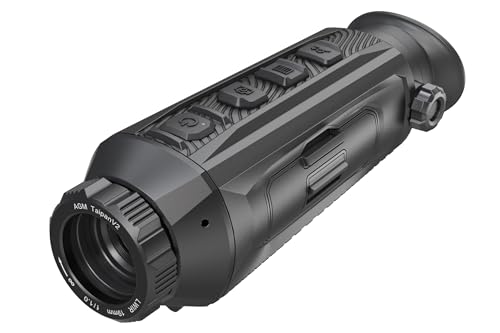
Focused framing when scanning width is secondary
Its 9.2° horizontal field is narrower than 19-384’s despite both using a 19mm lens. The manufacturer’s ambiguous detection-unit notation is excluded here rather than converted into a misleading range number.
The buying decision
The V2 19-320 is the model that demonstrates why a buyer must read beyond the lens number. AGM specifies a 320 × 256 detector, 3× base magnification and a 9.2° horizontal view. That is a focused optical arrangement. It should not be placed beside the 19-384 as though the only distinction were a minor resolution change.
For someone repeatedly checking a particular open lane, the tighter framing is a reason to investigate. For someone searching from left to right without knowing where activity may appear, it creates a coverage tradeoff. Our field-of-view tool makes that geometric difference visible at your chosen distance. The result describes scene width, not detection or animal-identification performance.
AGM’s product page also uses an ambiguous meters/yards notation for detection range. We have left that claim out of normalized distance comparisons. Converting it by guesswork would add false precision to a purchase where usable range is already highly dependent on subject and conditions. Ask for an unambiguous official specification if that headline figure is influencing your decision.
The listed six-hour runtime and replaceable 18650 arrangement give you practical power details to compare with the wider V2 models. Consider this 19-320 for its specific framing, then compare the 15-384 if broad searching remains important. We have not performed an image test. On Amazon, keep the complete 19-320 suffix in view so the selected variation matches the analysis you used.
Documented specifications
| Specification | Published detail |
|---|---|
| Native thermal sensor | 320 × 256 pixels |
| Objective lens | 19 mm |
| Horizontal field of view | 9.2° |
| Manufacturer-rated runtime | Up to 6 hours; actual use varies |
Published specifications are manufacturer or exact-listing claims, not our measurements. “Not confirmed” fields are left out of numeric recommendations.
Useful alternatives


Make sense of the differences
LearnThermal Monocular Field of View: Choose Width Before Zoom
Translate thermal field of view into scene width, compare exact model variants, and understand the tradeoff between scanning and framing.
Learn384 vs 640 Thermal Sensors: What the Extra Pixels Buy
Understand native thermal resolution, field of view, cropping, and why a 640 sensor is not an automatic long-range identification guarantee.
Sources & specifications
Source details checked September 10, 2026. Published claims are not independent test measurements.